(The above video was edited from a longer conversation, the highlights of which follow below:)
Who are you and where are you based?
I’m Marius Randakevičius, a programmer at Baltec CNC Technologies, based in Kaunas, Lithuania, in Eastern Europe.
We deliver high-quality components to industries including medical, automotive, industrial machinery, and laser technology. More than 90% of our customers are located in Germany, Switzerland, and Scandinavia.
Who are your customers and what do you machine for them?
Our customers are mainly in high-precision sectors – medical, automotive, and industrial machinery – and we produce complex component parts for them. We focus on quality and precision, so we constantly look for ways to make our processes faster and more accurate.
What were the main challenges you faced in your business?
Our main challenge was a lack of people and a lack of competencies. That’s one of the biggest issues we face. We only have about three programmers who work constantly on projects, and they also need to help operators with tools, measuring, and fixturing. They do a double job!
How did you get started with CAM Assist?
We started using CAM Assist in December 2024. We began properly in February 2025, after we created our libraries. At first, it was a bit messy because we tried to make our libraries as good as possible. We took all our tooling and holdings and made about 500 combinations, creating separate parameters for each tool. It took a while, but once it was done, everything worked much better.
How does CAM Assist fit into your workflow?
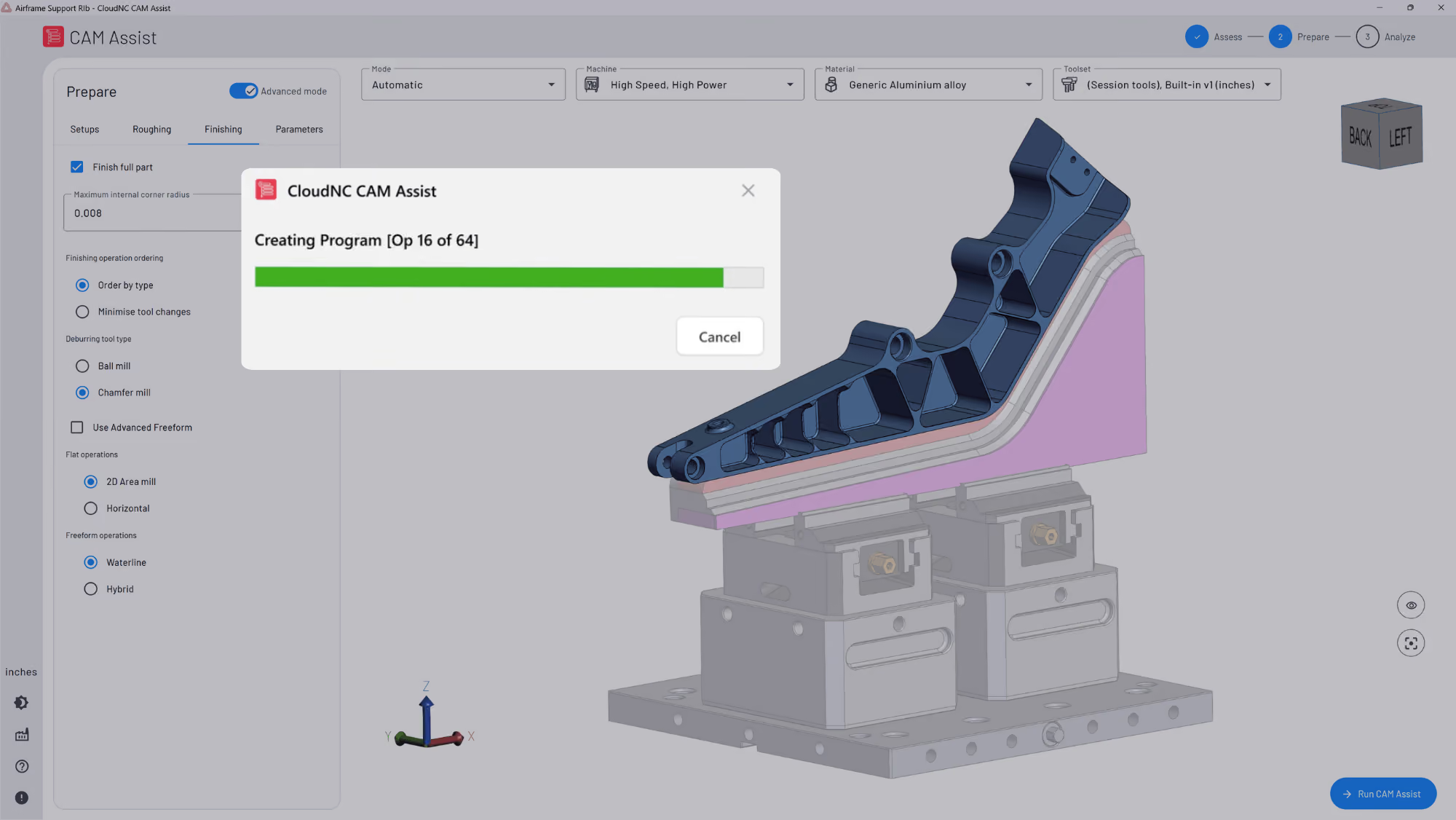
When we get an enquiry, we filter what parts can be calculated with CAM Assist. I take those parts, put them in Mastercam, add fixturing systems, define the tools we want to use, and then CAM Assist generates the toolpaths. After generating, I just make corrections – how it should be in reality.
What difference has it made?
When we use CAM Assist for calculations, it helps us a lot because it makes things faster and very precise – about 10 minutes, sometimes even 5. Before, for some complex parts, one operation could take an hour or more to program. Now, with CAM Assist, it saves me about 50% of my time on every job. It also makes my calculations more accurate.
It saves time and improves precision – those are the main benefits. Our enquiries are calculated much faster and more accurately, and that’s where we win with this product. And because we can calculate faster and more accurately, our customers benefit from faster responses and more reliable quotations.
What are your future plans with CAM Assist?
Right now, we’re using CAM Assist mainly for calculating programs – for estimating and quoting. In the future, we’re planning to use it as a programming tool.
If CAM Assist continues to improve, it will be used by many CNC milling companies – not only to speed up programming tasks but also to help identify the most efficient machining strategies. It can be excellent support for junior engineers responsible for programming. And for companies where operators need to write programs, they can generate half the work and just make corrections – and voilà, you have your program. These companies can save money and work much more efficiently.