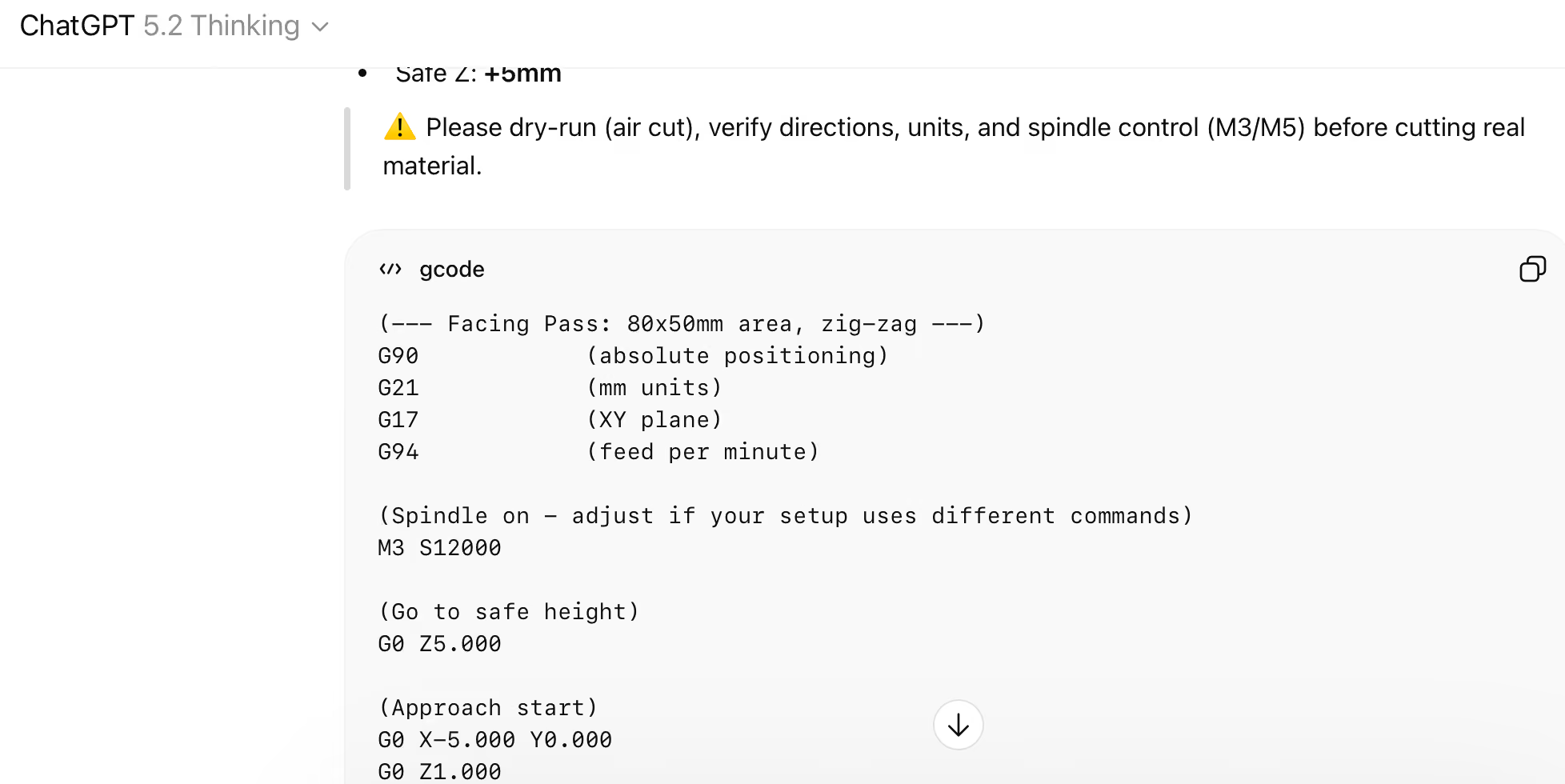
If you have ever stared at a CNC program and thought, “Can AI write this for me”, you are not alone. One of the most searched questions in manufacturing right now is can I use ChatGPT (or a similar LLM generative AI) for generating G-code.
The honest answer is:
- Yes, ChatGPT can produce G-code-like output.
- No, you should not trust that output as machine-ready without proper verification.
Because unlike a draft email, a mistake in G-code can break tools, scrap parts, or damage a machine.
This article covers what ChatGPT is good at, where it is risky, and how to use it in a way that supports CNC programming without putting the shop at unnecessary risk.
Key takeaways for CNC programmers
- ChatGPT can help you understand, draft, and sanity-check G-code concepts.
- ChatGPT does not “know” your machine, setup, tooling, post, or safe positions unless you supply them, and even then it can be wrong.
- The safest stance is simple: do not run AI-generated G-code on a machine unless it has been reviewed and validated using your normal process.
- AI can still be useful when it supports a workflow that includes CAD, CAM, simulation, and post processing.
What is G-code and why it is unforgiving
G-code is the instruction language that controls CNC motion and machine functions. It can define:
- Where the tool moves (axes and coordinates)
- How fast it moves (feed rates)
- Spindle speeds and direction
- Canned cycles (drilling, tapping, boring)
- Coolant, tool changes, and other machine commands
The reason programmers take it seriously is that G-code is executed literally. If something is off, the machine does not “guess what you meant”. That is why unverified code is a risk, regardless of whether it came from a human, a template, or an AI tool.
Can ChatGPT generate G-code?
Yes. ChatGPT can generate basic G-code patterns and it can often produce syntactically plausible programs, especially for:
- Simple 2D moves and contours
- Basic drilling cycles (for example G81 style patterns)
- Example program structure (headers, safety lines, comments)
- Macro concepts and variable explanations (controller-dependent)
- Explanations of what common G-codes and M-codes do
This can feel impressive, and it can be helpful.
The problem is not that ChatGPT “cannot write G-code”. The problem is that it cannot reliably prove the G-code is correct and safe for your specific situation.
Why you should not trust raw ChatGPT output to run a machine
If your goal is to make real parts on real equipment, the “can I” question becomes “can I trust it”.
Here is why unverified AI-generated G-code is a bad bet.
It has no direct understanding of your part geometry
ChatGPT does not load your CAD model, inspect features, or calculate real toolpaths from geometry. It generates text from patterns in its training data plus what you describe in the prompt.
For simple educational examples, that is fine.
For real parts, a text-only description rarely includes enough detail to be safe.
It does not know your controller dialect and shop standards
G-code varies by control and by shop conventions. Even the same “style” of code can behave differently depending on:
- Controller family and options
- Work coordinate setup (G54 style conventions, probing routines, offset strategy)
- Tool change conventions and safe positions
- Units, plane selection, cutter compensation expectations
- How your post typically outputs arcs, canned cycles, and retracts
ChatGPT can easily produce code that looks normal but is subtly incompatible with your environment.
It cannot simulate, backplot, or collision-check
This is the biggest practical gap.
CAM and verification tools help identify:
- Collisions with fixtures, stock, clamps, or the machine
- Gouging and overcut conditions
- Axis limit violations and overtravel
- Unsafe retracts and approach moves
- Tool engagement issues that break tools
ChatGPT cannot run those checks. It can only give you text.
It may sound confident even when it is wrong
A language model can produce confident output that contains incorrect assumptions, missing safety lines, or parameters that do not match the described operation.
That “confidence” is part of what makes copying and pasting risky.
The balanced view: where ChatGPT is genuinely useful
Taking a cautious stance does not mean ChatGPT has no value in CNC work. It can be useful when you treat it as a support tool, not as a post processor.
- Using ChatGPT for learning and understanding
This is one of the best use cases.
ChatGPT can help:
- Explain what a line of G-code does in plain language
- Describe common modes like absolute vs incremental
- Outline what canned cycles typically require (at a conceptual level)
- Suggest why a program might alarm (based on the error message you provide)
For apprentices, new CAM users, and anyone refreshing fundamentals, it can be a fast way to clarify concepts.
- Using ChatGPT to draft templates and comments
Another safe area is support content that improves clarity:
- Program headers and comments
- Operator instructions and setup notes
- Simple checklists for prove-out steps
- Explanations of workholding assumptions
You still review it, but the risk is far lower than direct tool motion.
- Using ChatGPT to create rough starting points for review
If you use it to produce a “first draft” that you plan to heavily review and test, it can save time on repetitive patterns.
The key is mindset: draft, not final.
A safer way to prompt ChatGPT about G-code
If you want to experiment with ChatGPT for generating G-code, prompt it in a way that reduces risk and makes review easier.
Here is a practical prompt pattern you can adapt:
- Ask for controller assumptions up front (for example Fanuc-style as a generic baseline)
- Request heavy commenting
- Request a non-machine-ready example meant for education
- Ask it to list unknowns and required inputs rather than guessing
- Ask it to include a review checklist at the end
Example prompt (for education and drafting only):
“Generate an educational example of G-code for a simple drilling pattern. Assume a generic Fanuc-style control. Add comments on every line. Do not guess tool numbers, offsets, or safe Z heights. Instead, include placeholders and a list of values the programmer must confirm. End with a checklist for verifying the program in simulation before any machine test.”
That framing pushes the output toward something you can review rather than something you might accidentally run.
Practical rules before any AI-generated G-code touches a machine
If you take only one section from this post, make it this one.
If you use ChatGPT for generating G-code in any capacity, follow these rules:
- Never run it “as-is”
Treat it like an untrusted draft from an unknown source. - Review every line
Confirm units, modes, planes, offsets, retract logic, and cycle parameters. - Verify with your normal tooling
Backplot and simulate using the same workflow you would use for any new program. - Prove-out safely
Start with conservative conditions, consider an air cut, and use controlled feed overrides where appropriate. - Confirm it matches your shop standards
Safety lines, tool change approach, coolant behaviour, and restart logic should align with how your shop runs.
This is not about being anti-AI (after all, we are an AI company!). It is about respecting the fact that CNC machines execute exactly what you tell them.
Why CAD and CAM workflows still matter
For real production machining, the most reliable path from part to program is still a workflow that includes:
- CAD geometry as the source of truth
- CAM toolpath calculation
- Simulation and verification
- Post processing that reflects your machine and control
AI can contribute meaningfully when it supports that workflow, rather than bypassing it.
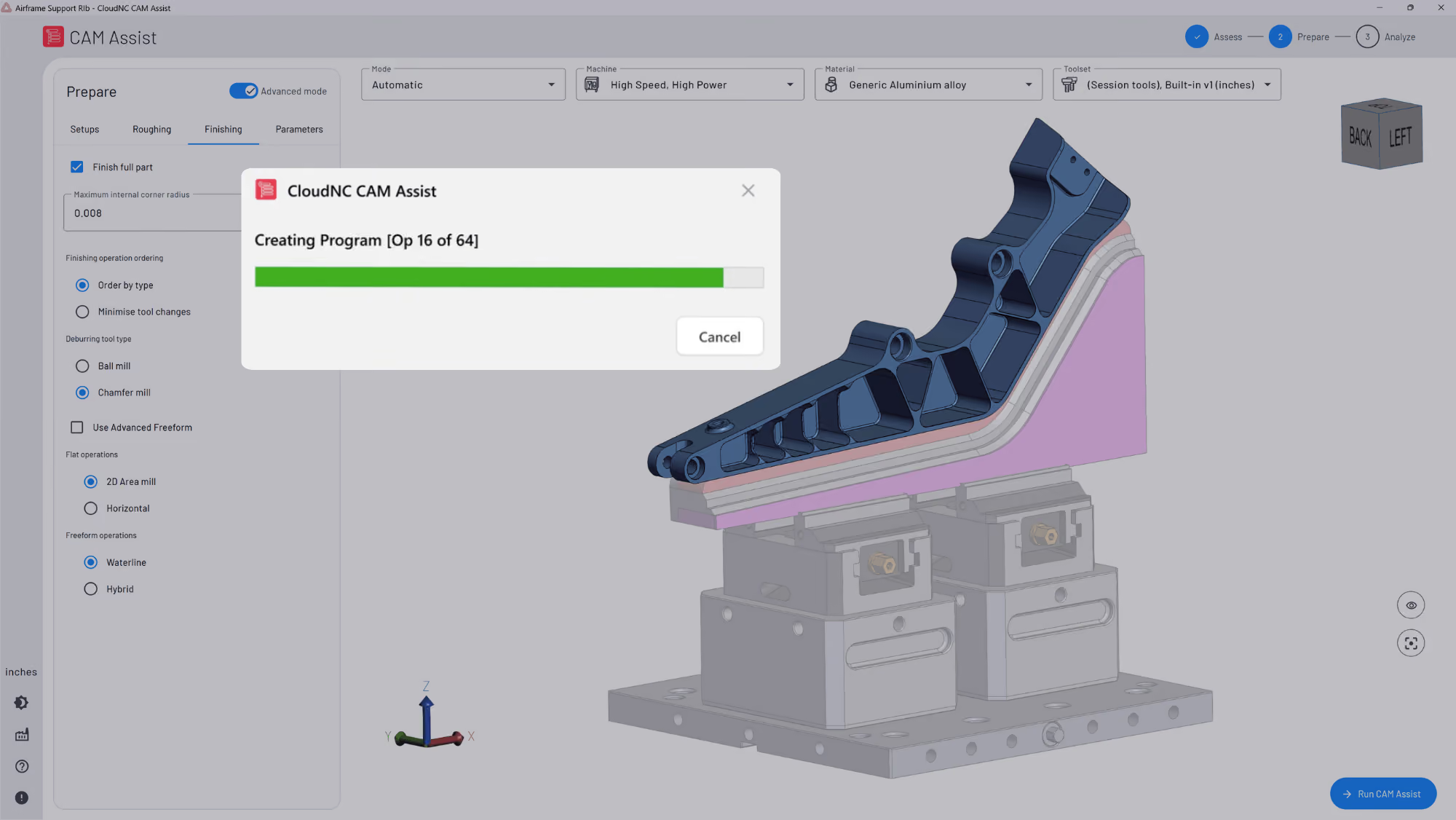
CloudNC’s CAM Assist is one example of AI being applied within CAM. The value of that approach is that it keeps programming anchored to geometry and familiar verification steps, instead of relying on standalone text generation.
FAQs about ChatGPT and G-code
- Can ChatGPT generate G-code for my specific machine?
It can generate text that resembles G-code, but it does not inherently know your exact machine configuration, post, or shop rules. If you do use it, you still need to validate everything in your normal process.
- Is ChatGPT a replacement for CAM software?
No. CAM software uses geometry-driven toolpath calculation and verification workflows that ChatGPT does not replicate. ChatGPT is better viewed as a support tool for learning, drafting, and documentation.
- Can I use ChatGPT to debug G-code?
Sometimes. If you paste a short snippet and describe the symptom or alarm, it can help explain possibilities. You still need to confirm against your control documentation and shop standards.
- What is the safest use of ChatGPT in CNC programming?
Education, explanations, documentation, and creating heavily commented drafts with placeholders that you then rebuild and verify properly.
Final thoughts
- So, can I use ChatGPT for generating G-code?
Yes, ChatGPT can generate G-code-like output. But you should not trust raw output to run on a CNC machine without review and verification.
Used carefully, it can be a helpful assistant for understanding G-code, drafting templates, and improving documentation. Used carelessly, it can introduce risks that are expensive in both time and hardware.
In CNC programming, safety and verification are part of the craft. AI does not change that.