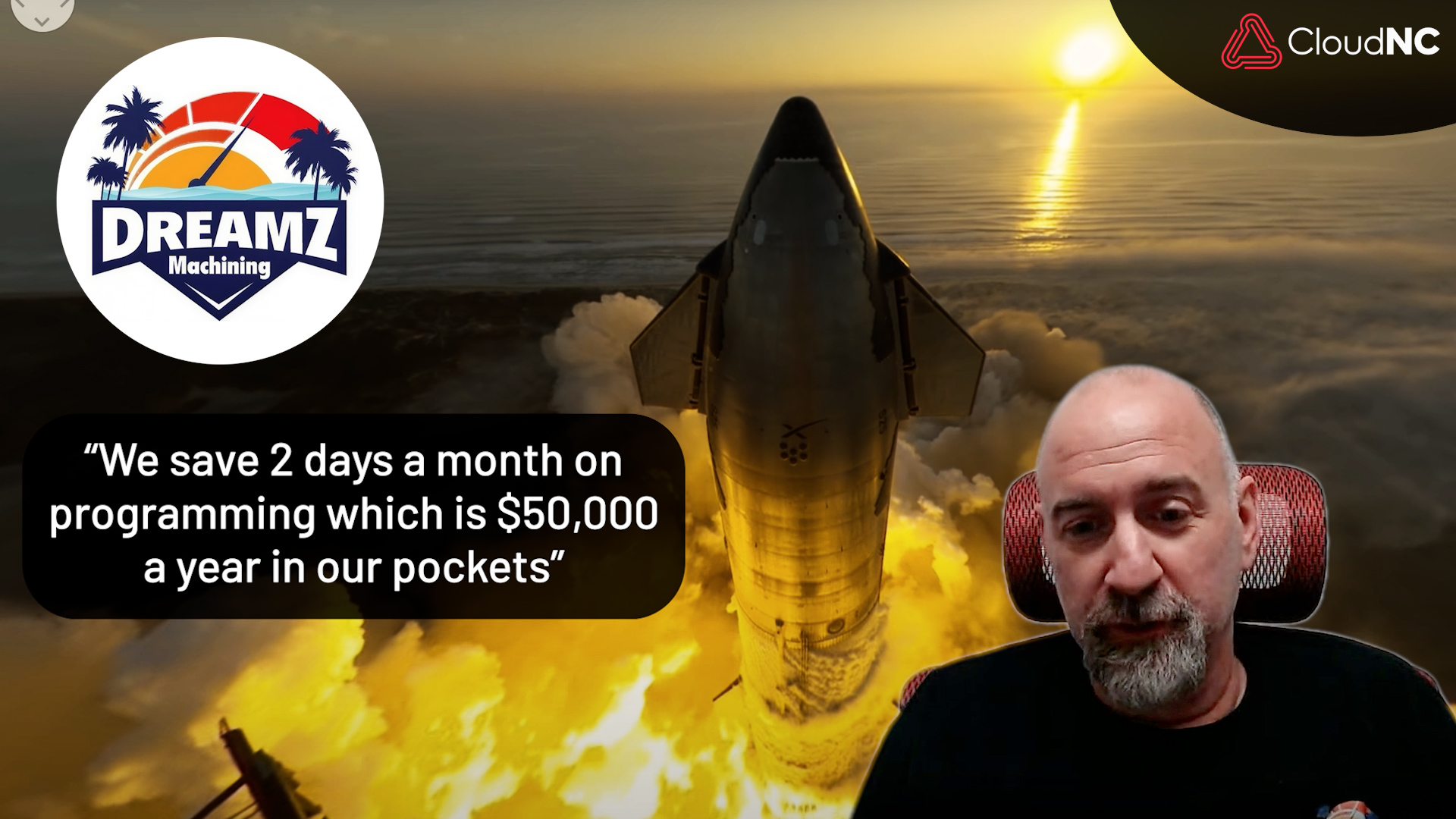
Dan Crnkovich of Dreamz Machining runs a small aerospace-focused machine shop in Longwood, Florida, just north of Orlando. We spoke with Dan about the challenges of running a small shop, how CAM Assist fits into the workflow, and why he believes manufacturers need to embrace AI-driven technology.
- Tell us about Dreamz Machining and the work you do?
We are Dreamz Machining. We are located in Orlando, Florida, just north of Orlando in Longwood, Florida. And we’ve been here at this location going on four years.
We do a lot of work for SpaceX, Blue Origin, Lockheed, Boeing, Northrop Grumman. We do mainly all aerospace work.
- What challenges do you have in your business today?
Time. Time is a killer for us. Between the programming, running the machines, the inspection portion. We’re a very small shop. There’s two of us full-time and one of the guys is part-time. He’s still going to school.
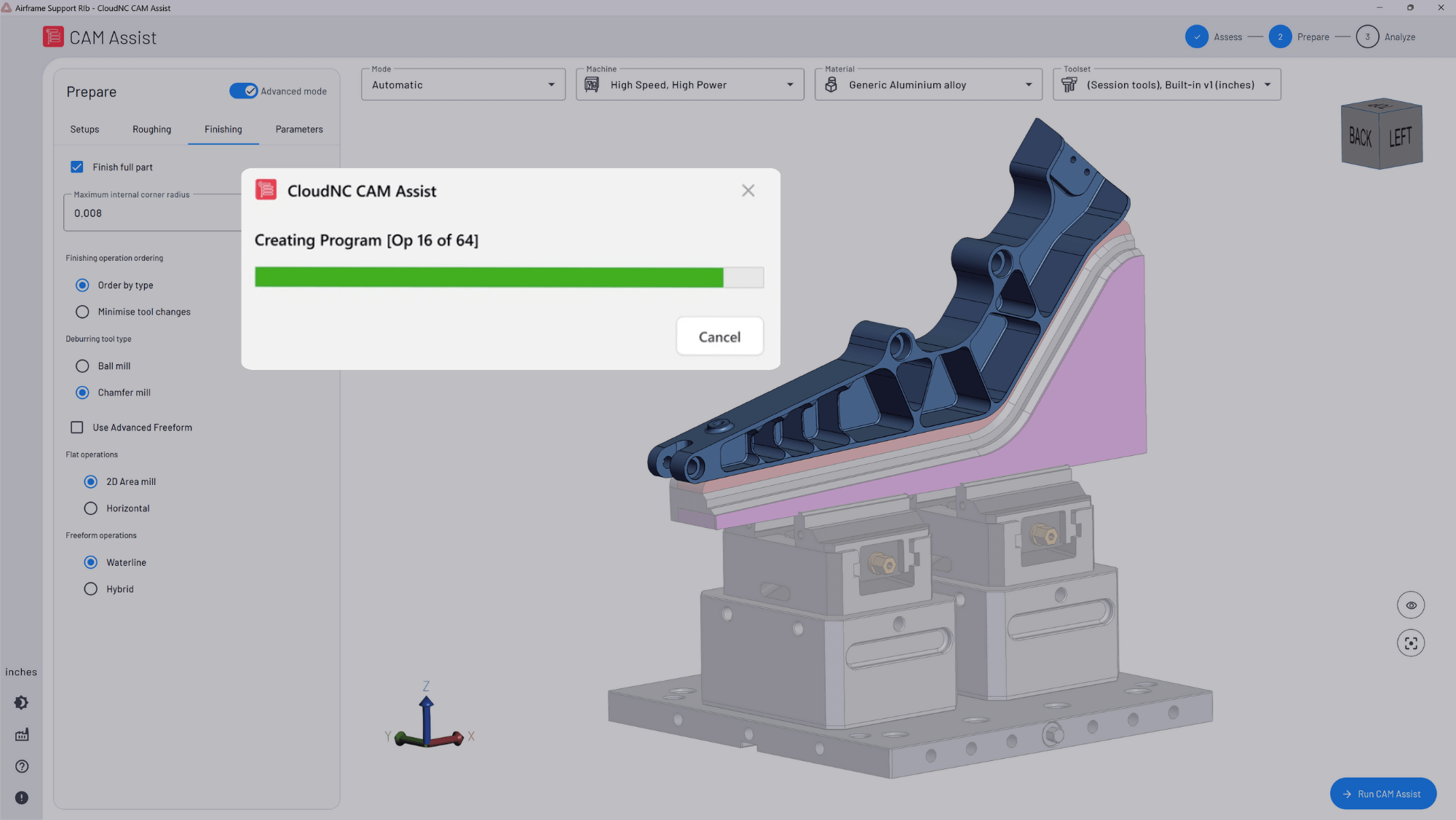
Having CAM Assist has been helpful to us because we can program parts quickly in the background. We’re working on job A, machining it. Job B is running in the background camming. So we do a little bit of multitasking, things of that nature. It really helps us speed things up. We can get from job to job to job quicker.
- When did you start using CAM Assist?
I actually ran into CAM Assist when you guys hadn’t even launched yet. I was looking for something along those lines - I was thinking - God, there’s got to be something out there. In today’s day and age, with AI, there’s got to be something available...
We have been using CAM Assist for roughly about a year and a half. 3+2 [axis] was coming out when we got on board. That’s really important to us as we do so much five-axis work, so it’s got to be able to do 3+2, especially on the roughing side. So, we’re happy with it and it’s a big time saver for us and we’re pleased to use it.
- How does CAM Assist fit into your workflow?
What we tend to do is we’ll let it run in the background chewing on the next job. As we’re working on part A, part B will open up, we’ll let CAM Assist go through, take a look at it, give us some options. We might go in and change a few things around. We might do like a first operation to the part and then bring CAM Assist in. It just depends on what kind of part we’re doing.
Sometimes we’re doing big surface plates and stuff like that. It’s awesome for that kind of work. That quick, easy work - it’s boring to CAM it manually. You just hit start and boom, there it is. It’s all done for you. Ten minutes, you’ve got a working program.
- What difference has that made to the business?
It is like having an extra person sitting there helping you out, and that’s the best way to go. Doesn’t call in sick and it works at night.
As far as CAM Assist, what it’s done for our business, it’s absolutely paid for itself. For the value [you pay]... to have a programmer basically sitting there working for you. Like I say, it works at night. Whatever we need, it’s always there. So, as far as value, dollars spent, it’s the best money spent.
Time-wise, it saves us a lot of time so that we can move to the next job just boom, immediately. It depends on the job. It could be we got to put in 30% more programming just because of the complexity of the job or sometimes, especially on flat plate work and easy work like that, simple boxes that we got to make for enclosures, they come out pretty much ready to run. There’s not much for us to do.
If it can save you all that setup time, it’s just more time that we have during the day to spend on the important stuff in my mind, which is making the part. Everything else leads up to machining the part. It has an inherent value, but unless the spindle’s spinning, you’re not making money.
- What has that meant in practical terms?
We’re just able to throughput more volume. That’s pretty much what it helps us do. Just looking back over time, we probably see an extra job or two a month, but that equates to a lot. When you’re looking at banging out an extra job or two a month, that’s basically like an extra week of work for us.
Some projects take a week. Well, if it can chew through and run all that CAM for us and we can push that job through, instead of taking seven days, it might only take us five days. Those two days are important to us.
- How do you want to use CAM Assist in the future?
We’re kind of hoping to see what you guys do as far as CMM programming. That would be a big one. That would be something that’s very helpful to most shops. CMM programming is in-depth and can take a while.
But the new 2.0 [upgrade] is certainly a step up for us. It helped us out a lot because we can go in and shift around operations of order before it spits out all the CAM programming and eliminate certain items and get it to do more like our order of operations.
As far as going forward, probably utilize it more and use it for training. We have a new guy that’s starting and he doesn’t have a lot of CAM programming background. What we found is if you take a simple part and run CAM Assist on it, they can see the order of operations through repetition. Even if it’s a simple box, you start to see how things are done, what the levels are. Boom, boom, boom. It just starts that repetition in their mind and it just clicks.
- What impact do you think CAM Assist is having on machining?
What you guys hit on and how far you brought this product in such a short amount of time - if it can get you 80% of the way, that’s close enough in my mind. If it can get you to 90% of the way in the future with more refinements, what it’s done is freed up programming because it’s hard to find quality people.
It’s AI driven. It’s computer driven. It looks at the problem the same way every time. There’s no variation. So, it’s always giving you the same machining programs and patterns and it’s very predictable what it’s going to give you and boom, there it is. So, I love that.
- What would you say to shops that are skeptical about AI?
Embrace the technology. It will make your life a heck of a lot smoother. It takes a little bit of learning. I mean you have to invest a little bit of time in the learning curve. You have to understand how the tools need to be labeled. You do have to put a little bit of time in on the front side, but what it gives you on the back side - embrace the technology because honestly, if you don’t, everybody’s going to run right past you.
What I see happening is because people can push through more parts, they’re starting to say, “Okay, our price point is here. We might be able to go just a little bit lower in the price point and still produce the parts at the same profit.” And they may be beating your bid. So, you’re going to have to adapt to the technology, embrace the technology, honestly, and let the machines do what they do.
- Final question: have any parts machined with CAM Assist made it into space?
Yes. We made some parts that are going up in the manned mission, but they altered the schedule on that. It was supposed to land on the moon, but now it’s going to do a rendezvous. So, there’s little parts, but still they’re up in space. It’s pretty cool.
[This interview has been condensed and edited for clarity]