
James Schuler is Director of Operations at Paragon Space Development Corporation in Tucson, Arizona. Paragon designs, develops and manufactures life support and thermal control management systems for manned spaceflight missions.
We spoke to James about the pressures of aerospace manufacturing, how Paragon uses CAM Assist in its workflow, and why he believes AI will play a major role in the future of machining.
- Who are you and where are you based?
My name is James Schuler. I’m the Director of Operations here at Paragon Space Development Corporation, and we are based out of Tucson, Arizona.
- Who are your customers, and what do you make for them?
Paragon Space manufactures, develops and designs life support and thermal control management systems for manned spaceflight missions.
Among our customers, we are partnered with NASA on quite a few different projects, and we are part of the Northrop team for HALO, the Habitation and Logistics Outpost. That will be our new lunar space station going into orbit hopefully in the next year or so.
Part of manned spaceflight includes keeping astronauts not only alive but also comfortable. We’ve made components for our humidity control systems, which maintain ambient humidity inside the cabin for astronauts to be comfortable. It also displaces that liquid so that it can be expelled from the craft or repurposed and utilized for experiments, drinking water purification, whatever needs to happen.
I’ve been part of our radiator program through my entire tenure here. I worked on body-mounted radiators for expelling heat from electronics off crafts. We’re part of the Dream Chaser team with Sierra Space and, probably our claim to fame here at Paragon, one of the things we’re best known for is our urine recapture technology. Currently on the International Space Station, we have our processing assembly, which recaptures 98% of water from urine on station for potable uses later on downstream.
- What challenges do you have in your business today?
Rapid development of components is a constant change in any environment, and in aerospace manufacturing in particular. With us, it’s the constant change in requirements that could come down at a moment’s notice. So it’s how do you pivot? How do you make adjustments for that?
We’ve got a product lifecycle management team who are constantly looking at what’s changing, what’s being tweaked to meet those demanding requirements, and then how we communicate that to the floor. As that communication comes across, it’s like, okay, that’s great, but now we’re going to have downtime and we have to reprogram this part that’s currently WIP. It’s on the machine running right now, we’re going to run that lights-out tonight, what are you guys going to do?
Before CAM Assist, getting designs through was a huge bottleneck for us. We can program the parts and we can get them done, but how are we going to [get them] through production? We’re making 500, 600, 700 parts every quarter, but we’re making low quantities of three, high mix, and very tight, very [precise] parts. The constant ebb and flow of those change as well. So how do you manage and track all that? That has been a very big challenge and a bottleneck for us in the past.
- When did you start using CAM Assist?
We started using CAM Assist about a year ago now, so we’re coming up on our birthday with the software.
- How do you use it? How does CAM Assist help you, and how does it fit into your workflow?
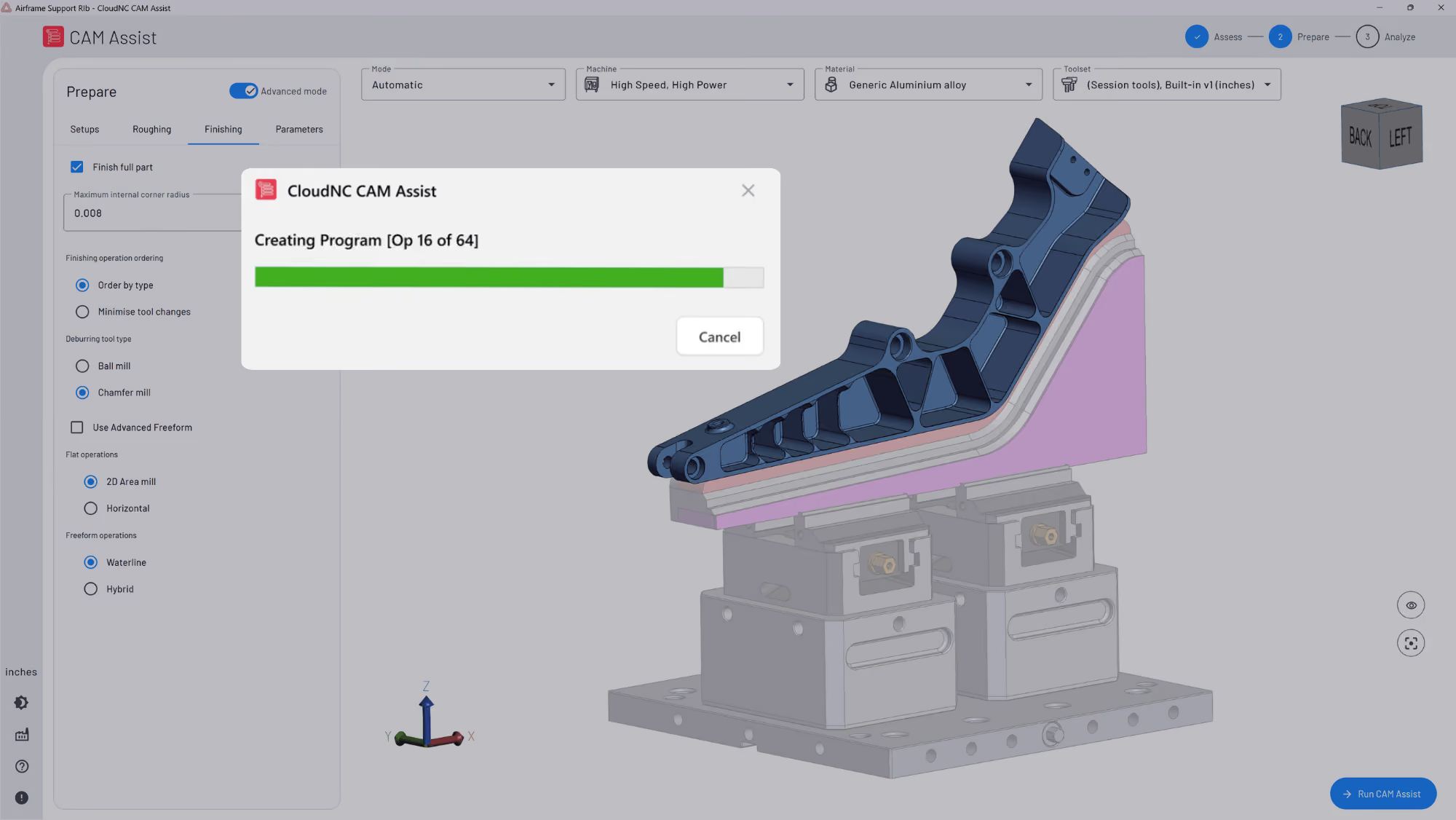
We use it primarily for reverse engineering the soft jaws. That’s our utmost favorite feature of the software itself. I was speaking with our machinist today and we were like, how are we going to hold this for OP 3? He said, “We’ll cut some soft jaws. I’ll have you a program in five minutes. You can start cutting on those. We’ll have this ready for lights-out operations by this evening.”
That has allowed them to cycle through being adaptive and being creative in how they approach work. Usually we’d have a queue of three, four, five projects ahead of that. If we said, “Oh man, we’re down for the night. We’re going to lose spindle time,” it’s like, “No, we’re not. Let’s pivot. Let’s standardize tooling. Let’s standardize what we’re doing, how our workholdings are.” CAM Assist has helped us in that, and in our roughing.
Even if we can’t finish a part, if we have the ability to run it lights-out in a roughing cycle, CAM Assist has given us the flexibility to use that sliding scale [in Cutting Parameters Explorer] back and forth for how aggressive we want to be with our toolpath. We run very conservative toolpaths when nobody’s here. It increases longevity of tool life. We come into a part that’s 60, 70, 80% complete by the time we walk in in the morning.
We use [CAM Assist] on anything from custom extrusions to billets to massive plate jobs. We have some GRT-type 510 gantry mills here we use for our radiators, big open flat-ended gantry-style mills. Those are just a massive footprint. So being able to wait for a quick roughing path to come in, or even just pop in a bunch of holes, the capability of doing that rapidly, setting the parameters, doing it once and then repeating that throughout the software has just been fantastic.
At the moment, just one person is using CAM Assist. Our main programmer feeds all of our machines. We have six CNCs in the factory. We’re small, but capability is the name of our game. We have a variety and mix of different styles of machines versus more throughput-oriented. We want to have the capability to make a wider variety of things versus a capacity to push 10,000 parts out the door.
- What difference has CAM Assist made to your business? What are the benefits to you?
It’s definitely allowed us to increase throughput. I would say being more efficient and effective.
We have tool validation software in tandem with CAM Assist, so having the ability to check its work via a third party has allowed us to trust the software more. So I don’t have guys sitting there watching a spindle turn for two-, three-hour cycle times. They’re happy to say, “Okay, I’ve touched off my tools. Nothing crashed. I can set a timer knowing this is going to run for 30, 40 minutes, come back,” and feel confident in the toolpath and what they’ve generated out of the software.
That confidence is huge. It means we can keep spindle time up, keep lights-out work moving, and get more throughput out of a small team.
Hands down, the soft jaws alone have paid for themselves. If we did nothing but utilize it for that, I think Paragon would have paid for the software in and of itself.
- What is the impact of you using CAM Assist for your customers?
Sometimes our customers come at us with, “Hey, everybody in our supply chain is bogged down. Do you guys have any open capacity?” We see this with some of our vendors as well as folks that say, “Hey, the shoe’s on the other foot. We’re behind. Can you help us out in a pinch?”
If we’ve got open spindle time, yeah, we’re happy to open it up and do some offline programming or even run the parts ourselves.
- How do you plan to use CAM Assist in the future?
I think it’s a scalable thing at this point. We are refining our tool libraries. That was one of the challenges we had when first implementing CAM Assist.
Part of that standardization of tools and workholdings has really helped us see and plot out our plan for optimization in the factory. So what does a standard layout look like? What type of parts best fit in which machine? I think the operators and the programmers are starting to communicate more effectively back and forth now, knowing that, “Hey, before we used to run this on our zero-point fixtures. We actually prefer to run this on the vacuum chuck now.” So let’s pivot how we’ve programmed this.
It allows us to be adaptive and to make those changes quickly without having to say, “I can’t afford a four-day delay to get this reprogrammed. I’ve got to get this back in the machine.” It has definitely allowed that communication and that planning aspect to be more thought through from an APQP standpoint, but for the operations side too: how are we going to approach a part and how are we going to take it to completion?
- What do you think the impact of CAM Assist will be on manufacturing and machining?
I think the biggest gap in manufacturing is for the apprehension [of using AI] to go away. During our initial sales call and consultation, one of the questions was, “What are you going to use it for?” For us, it was that next logical progression. What operation steps do we feel confident that this could handle?
If you only utilized [CAM Assist] for soft jaws and roughing operations, I would ballpark for us that it has been about 40 to 50% efficiency gained back in our day-to-day. And that’s in a high-mix, low-volume type environment. I’d say that’s fairly impressive considering we have one programmer feeding six machines.
If that’s the thing you’re looking for, if you’re a small shop and you’re looking to scale yourself as a solo programmer, or even utilize it as some training wheels for those that don’t necessarily have the experience but you need to help your programming department get a little pep in their step, I think there are opportunities for people. But they have to be willing to try new things.
I think we in operations and manufacturing get stuck in our ways sometimes. So it’s going to be breaking that mold that is the challenge with AI in manufacturing, not just CAM Assist but across global adoption.
- Anything important that the above doesn’t cover?
One of the biggest things for people looking to adopt CAM Assist is: definitely have your ducks in a row. Look at what you need to do, do that pre-emptive work so that when you do move forward, you’re ready to hit the ground running.
Not having your tool libraries established with the commonality of tools that you use every day can slow you down. CAM Assist is great in the sense that it will recommend tooling for you, but as we’ve all experienced, you can quickly grow that library of tooling to 10,000 different tools and that’s not the objective here. The objective is to be efficient and effective.
So get in there, make sure you’ve done your due diligence, you understand, you have a plan for what you intend to use it for, and start small. Don’t try and go across the entire organization. Be very targeted. Specify one or two jobs or even a machine or a work center and start working through it from there, seeing what you can do to build a solid foundation. Once you’ve done that, replicate that work center throughout the rest of the factory and you’ll be glad that you did.
[This interview has been condensed and edited for clarity.]