Unplanned downtime is one of the fastest ways for a CNC shop to lose margin. A spindle alarm, failing pump, worn tool, warm bearing or unexplained vibration can turn a profitable job into a scheduling problem in minutes.
That is why predictive maintenance for CNC machines is moving from an Industry 4.0 talking point to a practical shop-floor priority. Instead of waiting for a machine to fail, or replacing parts only because a service interval says so, predictive maintenance uses machine data to spot early signs of wear, instability or failure risk.
For a machine shop, the goal is straightforward - to avoid the 8 wastes of lean manufacturing, including:
- Fewer surprise stoppages
- More planned interventions
- Better use of operators and spindles
- More confidence when running long-cycle or unattended jobs
Why CNC downtime hurts so much
Downtime is rarely just one cost. The repair invoice is only the visible part.
A single unexpected stop can also mean:
- Lost spindle hours
- Operator idle time
- Rescheduled jobs
- Overtime to catch up
- Expedited tooling or spare parts
- Scrapped work-in-progress
- Late delivery penalties or unhappy customers
Fluke’s October 2025 downtime release found that 61% of manufacturers surveyed had suffered unplanned downtime in the previous year, with sector losses estimated at up to $852 million per week. One machine going down can block multiple jobs, especially when it is a bottleneck machine, a 5-axis machine, or the only machine qualified for a specific part family.
That is why CNC machine downtime reduction is not just a maintenance issue. It is a capacity, delivery and profitability issue.
How predictive maintenance works on a CNC machine
Predictive maintenance compares what a healthy machine normally looks like with what the machine is doing now.
Most CNC machines already produce useful signals, including:
- Spindle load
- Servo load
- Alarm history
- Cycle times
- Feed rates
- Tool changes
- Axis behaviour
- Temperature trends
Additional sensors can add more detail, especially for older machines or mixed fleets. Common inputs include:
- Vibration sensors
- Temperature sensors
- Acoustic or ultrasonic sensors
- Current or power monitoring
- Lubrication and coolant data
AI models then look for patterns. The useful question is not simply: “Has this value crossed a limit?” It is: “Is this machine starting to behave differently from its own normal pattern?”
For example, a fixed vibration threshold might only trigger when a bearing problem is already obvious. Recent research shows how this can work in practice: a 2025 Springer paper used vibration data from a low-cost sensor and an unsupervised autoencoder model to detect anomalies that may indicated wear, imbalance or early-stage faults.
From reactive to predictive maintenance
Most shops do not jump straight into AI-driven maintenance. They move through stages.
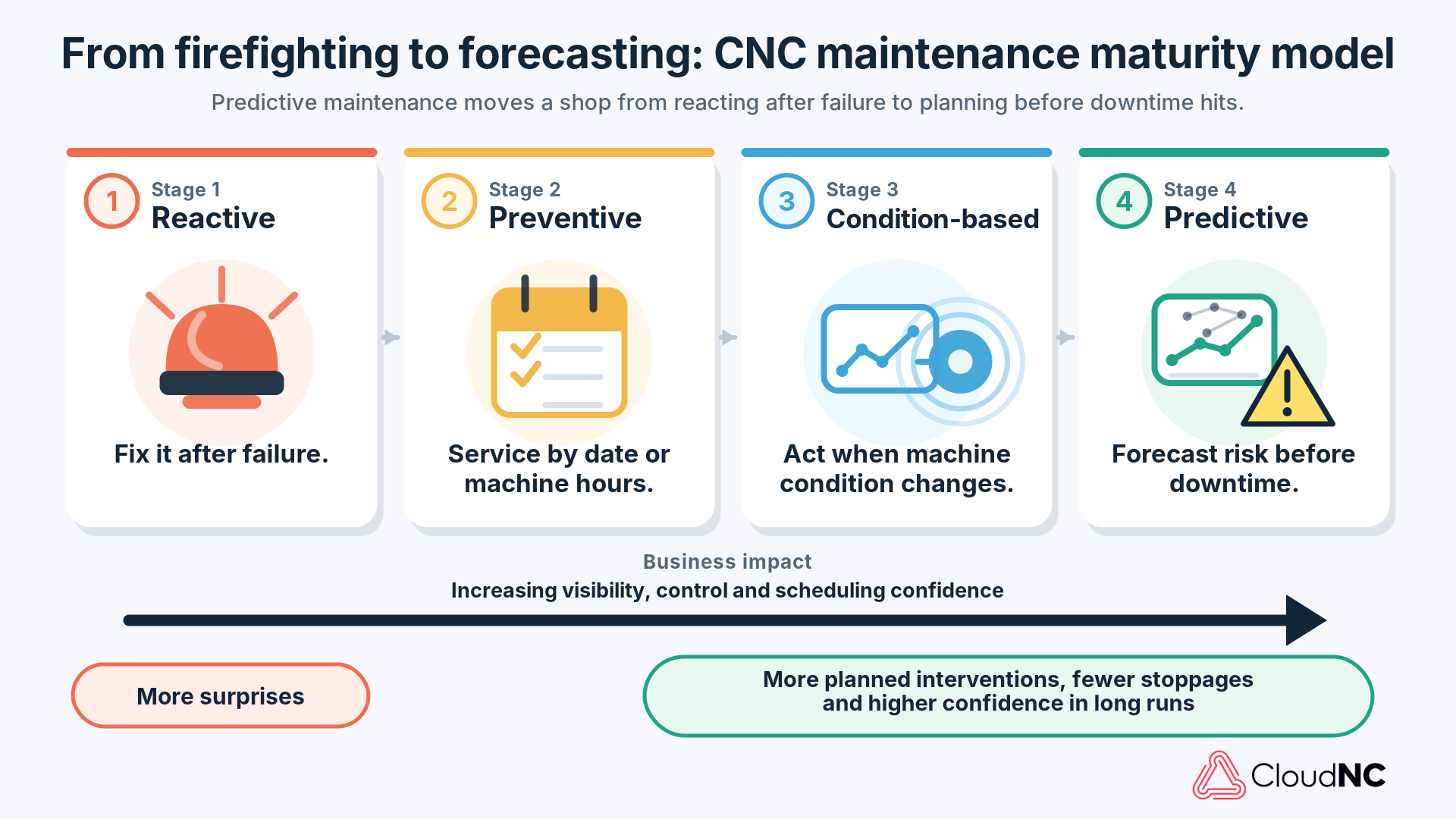
Reactive maintenance
This is the “fix it when it breaks” stage.
- Upside: no unnecessary maintenance work
- Downside: failures happen at the worst time
- Typical result: firefighting, schedule disruption and expensive surprises
Preventive maintenance
This is calendar- or hour-based maintenance.
- Filters are changed on schedule
- Pumps, belts and lubrication systems are inspected regularly
- Spindle checks happen at planned intervals
Preventive maintenance is much better than waiting for failure, but it can still miss problems between service intervals. It can also lead to replacing components before they really need replacing.
Condition-based maintenance
This approach uses the actual condition of the machine.
- Vibration rises
- Temperature changes
- Spindle load trends upward
- Alarm frequency increases
- Oil, coolant or lubrication data looks abnormal
For many mid-sized CNC shops, this is the practical first step towards predictive maintenance. It turns maintenance from a calendar activity into a data-backed decision.
Predictive maintenance
Predictive maintenance goes further by using historical data, live signals and AI models to estimate what is likely to happen next.
The maintenance question changes from:
“What failed?”
to:
“What is starting to degrade, how quickly is it changing, and when should we intervene?”
That shift is where the value is. A planned two-hour intervention on Friday afternoon is very different from a spindle failure on Monday morning.
Real results, with caveats
AI-driven maintenance is moving from theory into practical use, but shops should be careful with headline claims.
Hurco’s 2025 article on AI in CNC machining describes predictive maintenance as a shift from scheduled or reactive repair toward monitoring machine condition through sensor data and performance analytics. Stecker Machine’s 2026 CNC trends article also identifies practical AI adoption around tool-wear detection, predictive maintenance and cutting-parameter recommendations.
For quantified CNC-specific results, MachineToolNews.ai’s 2026 interview with IPercept reports vendor-supplied customer-base figures including:
- 30% improvement in overall equipment effectiveness
- 50% reduction in unplanned downtime
- 40% reduction in unnecessary scheduled maintenance
Those results are useful, but they should be treated as vendor-reported examples rather than guaranteed outcomes. The safer takeaway is this: predictive maintenance works best when it is tied to a specific operational problem.
What you need to get started
A CNC shop does not need to connect every machine on day one. Start with the machine that hurts most when it stops.
That might be:
- The highest-utilisation mill
- The only 5-axis machine
- A machine with a history of spindle issues
- A machine running long unattended cycles
- A bottleneck machine that controls delivery on key jobs
A practical starter setup usually includes:
- Controller data: spindle load, servo load, alarms, cycle times and tool changes
- Maintenance records: what failed, when it failed and what it cost
- Operator notes: noise, vibration, finish issues, warm-up behaviour and recurring faults
- One or two external sensors: vibration and temperature are common starting points
- A simple dashboard or alert workflow: something the team will actually check
Fluke’s May 2026 predictive-maintenance adoption survey found that predictive maintenance adoption doubled year on year from 9% to 18%, while reactive maintenance stayed flat at 36%. The same survey points to workforce skills as a major barrier to digital maturity.
That is an important lesson for smaller shops: the technology matters, but ownership matters more. Someone must review the data, trust the alerts and turn them into action.
Predictive maintenance checklist for CNC shops
Before investing in a system, answer these questions:
- Which machine causes the most disruption when it stops?
- What are the top three recurring failure modes?
- Do we already capture spindle load, alarms, tool life or maintenance history?
- Which operator observations should be logged consistently?
- What would one avoided failure be worth?
- Who owns the daily or weekly review of machine-health data?
- How will alerts turn into action?
- How will we measure success after 30, 60 and 90 days?
The last question is the most important. Data does not reduce downtime by itself. A shop only gets value when the data changes decisions.
FAQs
How does predictive maintenance work in CNC machining?
Predictive maintenance in CNC machining uses machine and sensor data to detect early signs of wear, instability or failure. It monitors signals such as spindle load, vibration, temperature, servo current, alarm history and tool behaviour, then uses AI models to flag patterns that suggest a future problem.
Is predictive maintenance only for large factories?
No. Large enterprises may use full IIoT platforms, but smaller CNC shops can start with one machine, controller data, maintenance logs and a small number of sensors. The best first step is to choose a high-impact machine and a clear downtime problem.
How does AI tool wear detection fit in?
AI tool wear detection in CNC machining looks for changes in cutting behaviour, such as rising spindle load, vibration, sound, surface finish issues or dimensional drift. The aim is to flag a worn or unstable tool before it breaks, causes scrap or stops the machine.
Which CNC machine should you monitor first?
Start with the machine that costs the most when it stops. In many shops, that is a high-utilisation mill, a 5-axis machine, a machine with expensive spindle rebuilds, or a bottleneck machine tied to key customer deliveries.
Final thought
Predictive maintenance will not fix weak workholding, poor coolant management or unsafe toolpaths. But it can give CNC shops something they often lack: earlier warning.
That warning turns maintenance from a surprise into a plan.
For shops under pressure to do more with the same people and machines, that matters. Combined with better programming and stronger process control, predictive maintenance can help create a more resilient shop: fewer emergencies, more reliable schedules and more spindle time spent making parts.
To reduce another source of lost spindle time - machines waiting for programs - explore CloudNC’s CAM Assist and see how AI CAM software helps teams move from CAD to cut faster.